
Utilities
Maturity analysis
CME Diagnostics
Homburg/Fürst 9-Dimensional Framework
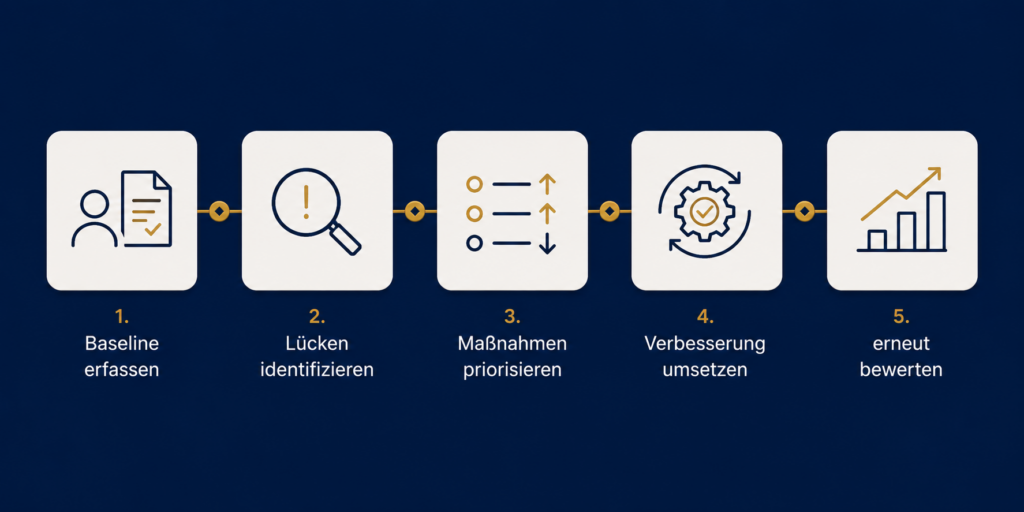
Internal assessments, scattered case data and isolated improvement measures failed to provide an objective overall picture. It was unclear whether the weaknesses lay in data entry, processing, analysis or monitoring. As a result, measures tended to be based on opinions rather than on a sound diagnosis.
If it is not clear where the greatest weaknesses lie, it is difficult to justify investments and improvements cannot be properly demonstrated at a later date. According to the document, this is precisely where the real problem with credibility and prioritisation lies.

Clarifall CME Diagnostics assesses complaint management across nine dimensions: complaint philosophy, encouragement, receipt, processing, response, analysis, monitoring, culture and human resources management. The key point is that the framework is externally recognised and scientifically established.
In particular, intake, processing, analysis and controlling are areas where Clarifall can have a direct impact. Culture and human resources management, on the other hand, form part of the organisational environment and cannot be changed by software alone. It is precisely this distinction that lends credibility to the approach.
ClariFall optimises the operational aspects of complaints management.
Structured and automated support is provided for data entry, processing, analysis and monitoring.
Structured case data provides a reliable basis for analytics and reporting.
On this basis, weaknesses can be identified and improvements prioritised in a targeted manner.
Corporate culture and human resources management remain the responsibility of the organisation and its leadership.
Software can help to organise processes, but it cannot replace a leadership culture or staff training.
The way in which complaints are assessed and communicated internally also requires organisational effort.
ClariFall highlights these areas and clearly identifies where further action is needed.
An objective starting point, identified weaknesses, a prioritised roadmap, repeatable measurement, a better basis for management decision-making, and a realistic distinction between software and organisational issues. These benefits stem directly from the functions and advantages described.